The Unknown Chronicles
What they are
There is a place where the broken things of the world are gathered.
Not the broken bones of the dead, nor the ruins of forgotten kingdoms.
But the things that fracture silently within the living.
The resentment left behind by betrayal.
The jealousy that grows beneath admiration.
The pride that refuses forgiveness.
The shame that survives long after the sin has been forgotten.
And the terrible emptiness of wanting something that can never be enough.
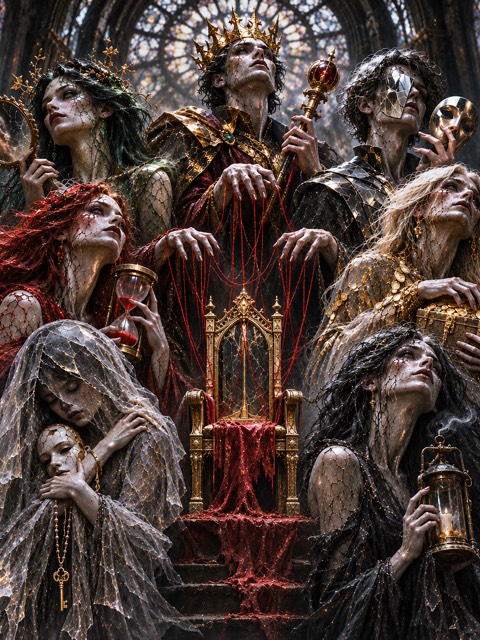
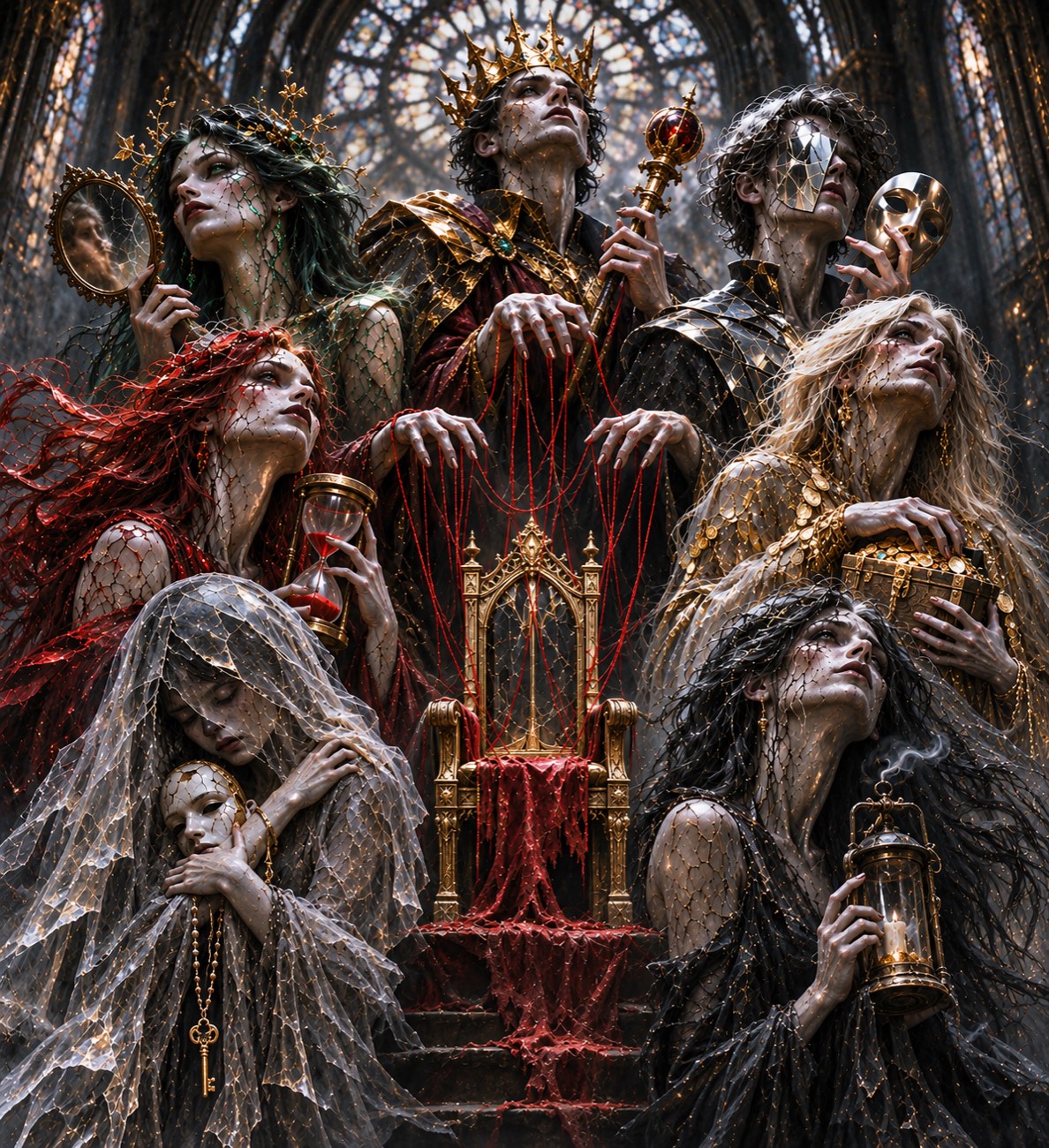
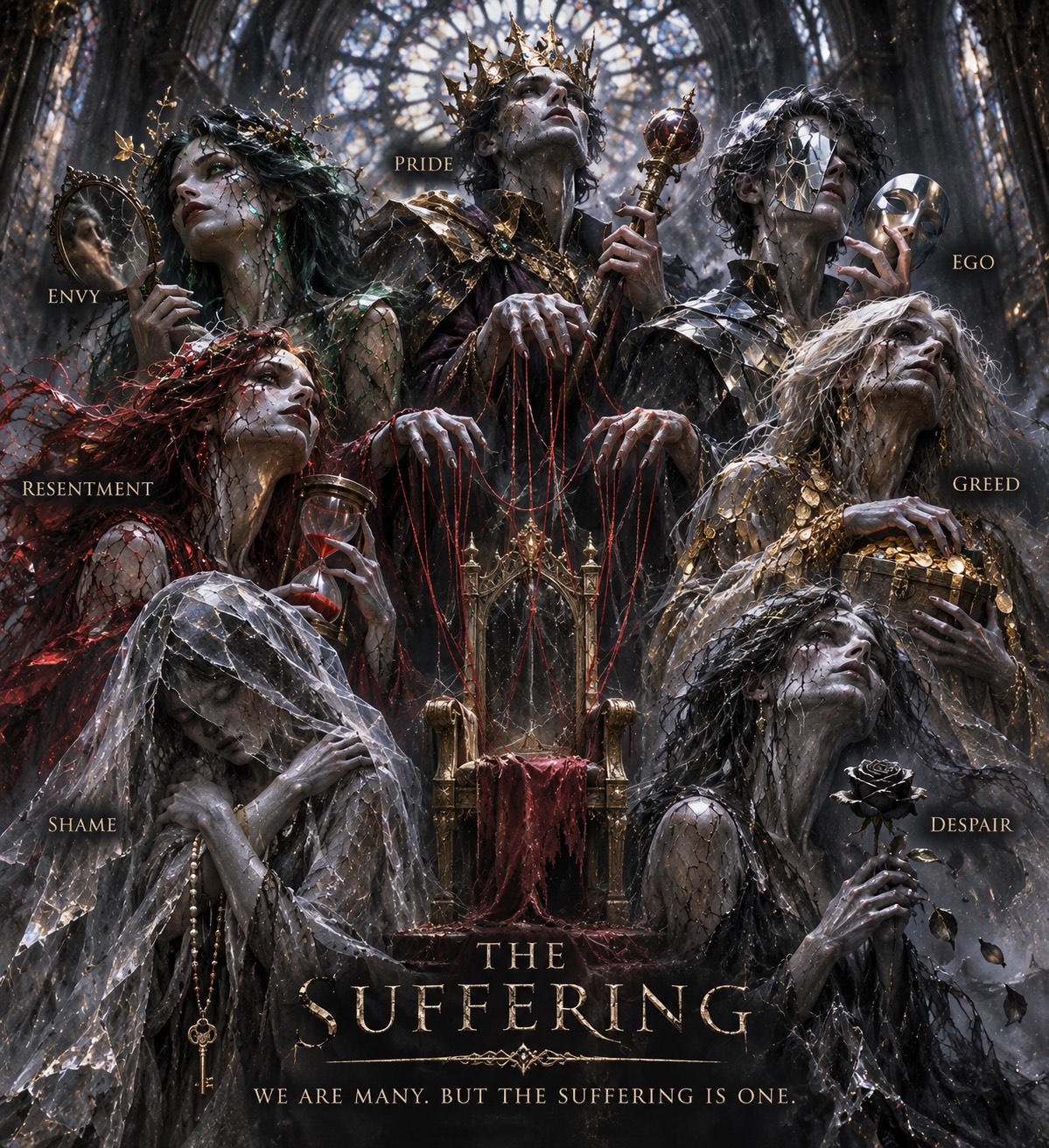
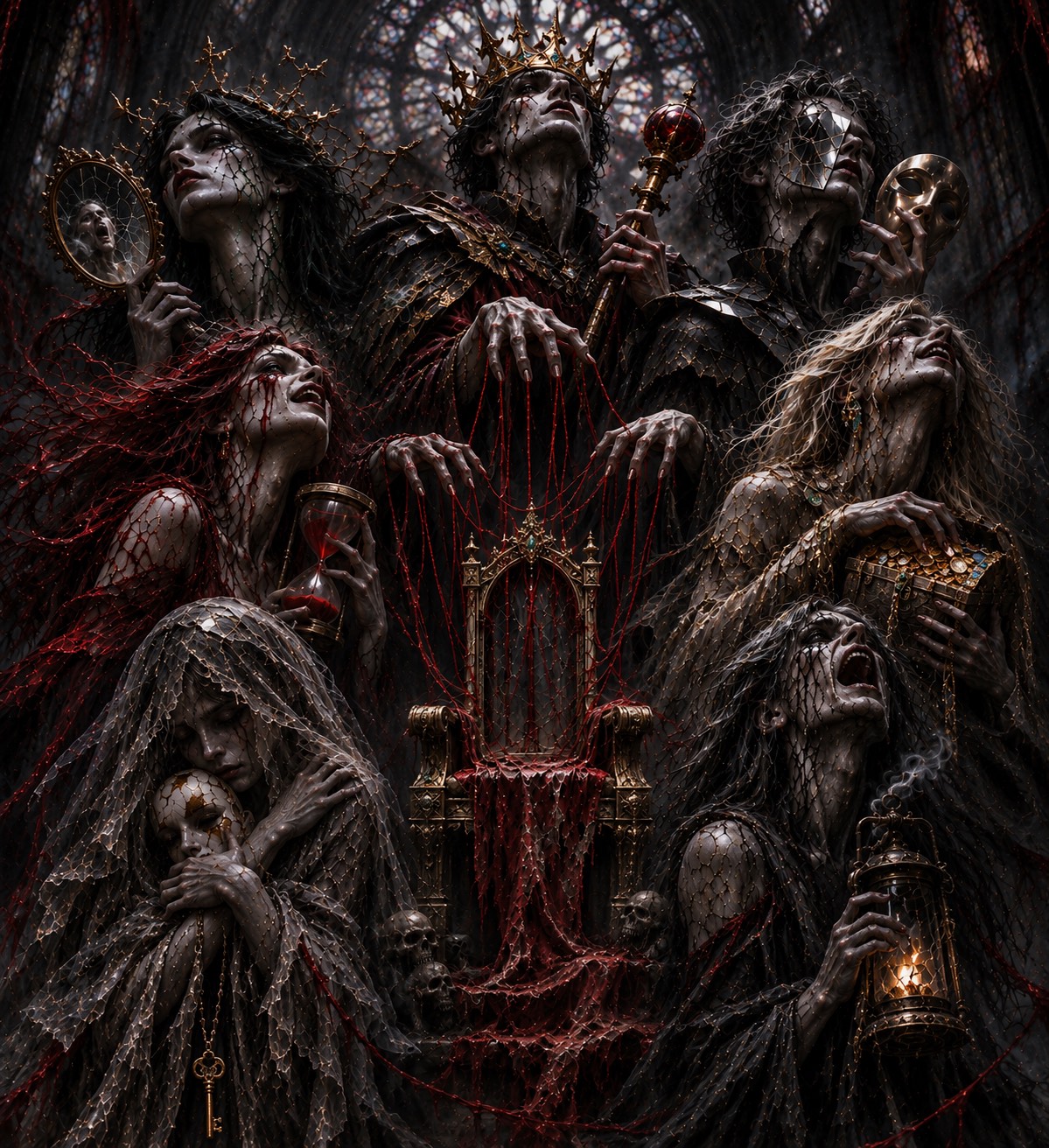
In that place, beneath the shattered windows of a cathedral that has not heard a prayer in centuries, seven figures gather around an empty throne.
They are beautiful.
At first.
Their faces resemble the finest porcelain, their bodies fashioned from translucent glass and gilded fractures. They wear the remnants of an ancient aristocracy, crowns and jewels, silk and lace, garments once magnificent and now rotting upon their unnatural forms.
But look closer.
Beneath their glass-like skin, something moves.
Their smiles stretch a little too far.
Their fingers bend at impossible angles.
And when they breathe, the sound resembles a thousand tiny mirrors breaking.
They are not seven strangers.
They are seven voices of a single affliction.
They are The Suffering.
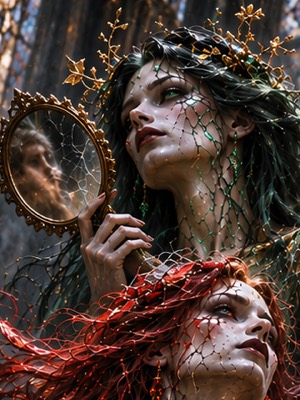
I
The Envy
The Poison of Comparison
“Why should they possess what you deserve?”
She carries an antique mirror, its surface clouded with the faces of those she envies.
Her skin is fractured emerald glass, and within every crack glimmers the reflection of something beautiful that belongs to someone else.
She never looks at her own reflection.
There is nothing there she wishes to see.
She does not demand that you destroy another’s happiness.
Not immediately.
She merely asks why it was not given to you.
And when you answer, she asks again.
Until every blessing becomes an insult.
Until every achievement feels inadequate.
Until another person’s joy becomes your private humiliation.
She is the first to whisper.
And often the last to be recognized.
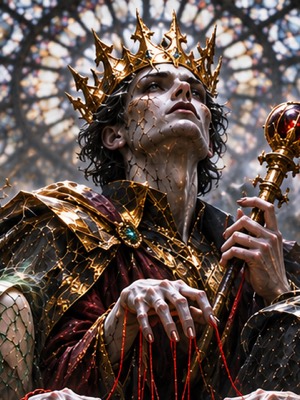
II
The Pride
The Crown of Isolation
“Better to break than to bow.”
He wears a magnificent golden crown, fractured and fused to the decaying glass of his skull.
In his hand rests a royal scepter, its jewels darkened by centuries of worship.
He stands taller than the others.
Even when his legs are breaking beneath him.
He does not apologize.
He does not forgive.
He does not kneel.
For he has mistaken humility for defeat, and vulnerability for weakness.
He would rather watch an entire kingdom burn than admit that he was wrong.
And when the last stone falls, he will stand among the ashes, crowned and utterly alone.
Still insisting that he has won.
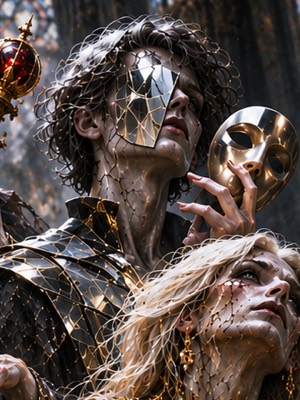
III
The Ego
The False Reflection
“You are nothing without the person I have made you.”
Its face is a mosaic of broken mirrors.
No two observers see the same creature.
To the ambitious, it appears powerful.
To the lonely, beloved.
To the forgotten, immortal.
It carries a polished silver mask, changing its expression whenever someone looks away.
It promises identity without understanding.
Importance without achievement.
Admiration without intimacy.
But beneath its many reflections, there is no face.
Only an endless terror of being ordinary.
It is perhaps the most fragile of the seven.
And therefore among the most dangerous.
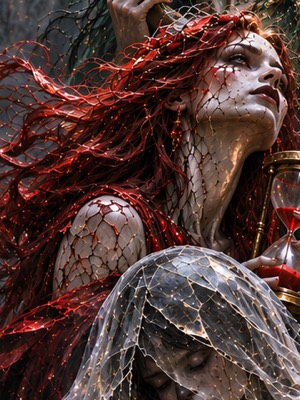
IV
The Resentment
The Keeper of Wounds
“Never forget what they did to you.”
Her hair is a tangled river of crimson threads.
Her body is covered in fractures that glow like wounds beneath red glass.
She carries an ancient hourglass filled with the blood-red dust of grievances that should have faded centuries ago.
She remembers everything.
Every insult.
Every betrayal.
Every moment of humiliation.
She preserves them with the devotion of a mother protecting her children.
But her children never grow.
And her wounds never heal.
She does not seek justice.
Justice might bring an ending.
She seeks remembrance without release.
For without the past, she fears there would be nothing left of her.
V
The Shame
The Veil of Unworthiness
“If they saw what you truly are, they would turn away.”
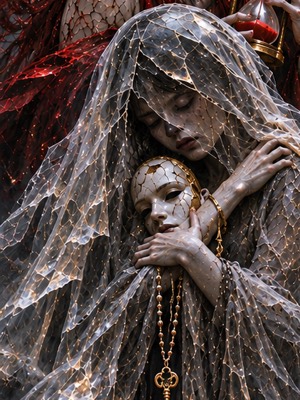
She kneels beneath a veil of shattered white glass.
Her face is hidden behind a porcelain mask, cracked from forehead to chin.
She carries an ancient key, though no one has ever discovered which door it opens.
She speaks so softly that her words are often mistaken for one’s own thoughts.
She does not tell you that you have committed a terrible act.
She tells you that you are terrible.
She does not ask you to repent.
She insists that redemption is impossible.
And when someone reaches out to love you, she whispers that they simply do not know you well enough.
Of all the seven, she rarely needs to raise a hand.
Her victims imprison themselves.
VI
The Greed
The Hunger Without End
“One more, darling. Just one more.”
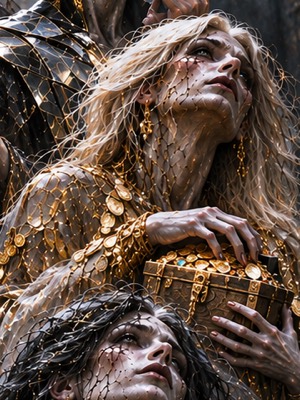
She is adorned in gold.
Chains hang from her neck. Jewels are embedded beneath her translucent skin. Her fingers glitter with rings taken from hands long since turned to dust.
She carries a gilded reliquary overflowing with treasures.
Yet its bottom is empty.
No matter how much she places inside, nothing remains.
She consumes beauty without appreciating it.
Power without understanding responsibility.
Love without offering affection.
She does not desire what she possesses.
She desires the moment before possession.
The anticipation.
The hunger.
The promise that the next acquisition will finally silence the emptiness.
But the emptiness is all she has ever known.
And so she feeds it.
Forever.
VII
The Despair
The Death of Possibility
“Why rise, when you will only fall again?”
The last figure stands apart from the others.
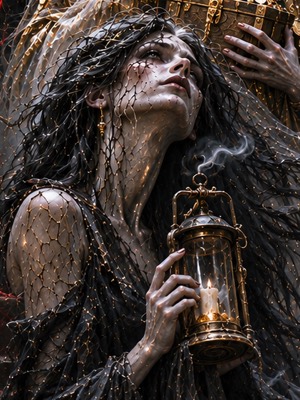
Its body is formed from smoky black glass, cracked so deeply that darkness leaks through its skin.
Its hair hangs like funeral threads.
In its hands rests an ancient lantern.
The flame has long since died.
Unlike the others, Despair rarely whispers.
It does not need to.
Envy has already convinced you that you are inadequate.
Pride has isolated you.
Ego has made you a stranger to yourself.
Resentment has chained you to the past.
Shame has taught you to despise your own reflection.
Greed has emptied everything you once cherished.
And when the others have finished, Despair approaches.
It sits beside you.
Places the extinguished lantern at your feet.
And waits.
It does not tell you to die.
It merely convinces you that nothing will ever change.
And sometimes, that is enough.
The Empty Throne
Ancient.
Magnificent.
Unoccupied.
Seven sets of crimson strings descend from the figures' fingers, gathering around its arms and winding through its broken crown.
The throne has no rightful ruler.
It has never needed one.
For whenever a soul becomes consumed by its own suffering, the throne is occupied once more.
Not by a king.
Not by a monster.
But by someone who has forgotten that the strings can be loosened.
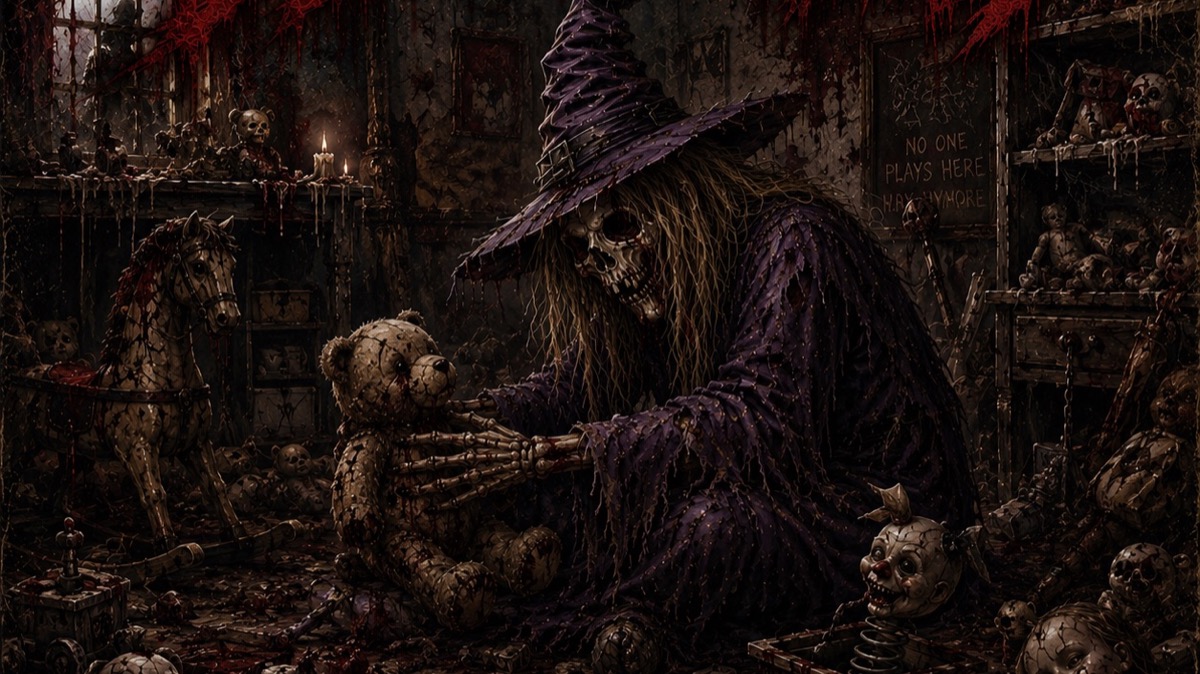
Once, a wanderer entered their cathedral.
He wore a battered pointed hat and the remains of a purple robe.
His face was hollow.
His body weary.
And his heart carried more wounds than he could remember.
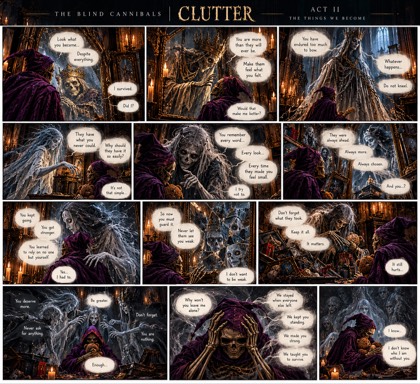
They recognized him immediately.
Not because they knew his name.
But because they knew his weaknesses.
Envy showed him the lives he might have lived.
Pride reminded him of everyone who had wronged him.
Ego offered him a crown.
Resentment placed an hourglass in his hands.
Shame whispered that he deserved his loneliness.
Greed promised him everything he had lost.
And Despair waited by the throne.
The wanderer listened.
He argued.
He resisted.
He surrendered.
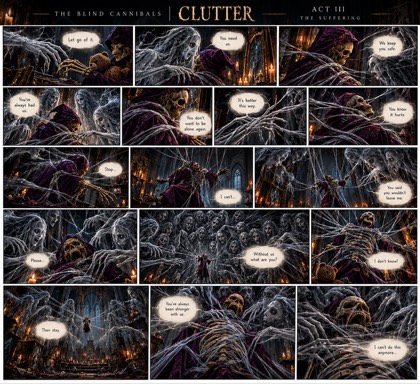
And slowly, the strings tightened.
Around his wrists.
Around his throat.
Around the remnants of the heart he had spent so long trying to protect.
The seven began to speak.
At first, their voices were distinct.
Then they overlapped.
Whispers became accusations.
Accusations became laughter.
Laughter became a single terrible voice.
“WE ARE MANY.”
The cathedral trembled.
“BUT THE SUFFERING IS ONE.”
The wanderer fell to his knees.
And the throne waited.
For a moment, it seemed that nothing in the world could save him.
Then, somewhere beyond the shattered windows, the wind began to move.
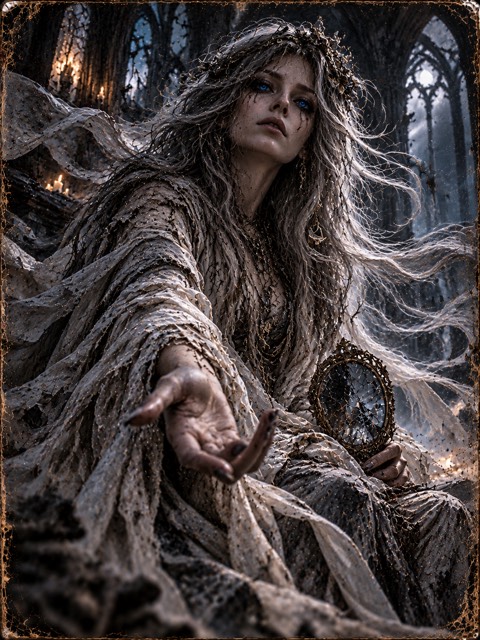
A pale figure appeared among the ruins.
Silver hair.
Tattered garments.
And two impossibly deep blue eyes.
The Pain had come.
The seven recoiled.
Not because she could destroy them.
But because she knew what they feared most.
To be seen for what they truly were.
She walked past them without drawing a weapon.
She knelt beside the wanderer.
And offered him her hand.
The strings tightened.
The seven screamed.
But she did not look at them.
She looked only at him.
“Hate me if you must, my darling. But rise.”
And somewhere within the darkness, a trembling hand reached toward hers.
The strings did not disappear.
The seven did not perish.
But for the first time, their hold weakened.
And the empty throne remained empty.
They are The Suffering.
The beautiful lies we tell ourselves.
The wounds we refuse to release.
The chains we mistake for protection.
The seven voices that become one when we forget how to listen to ourselves.
“We do not imprison you, darling. We merely hold the chains you refuse to release.”